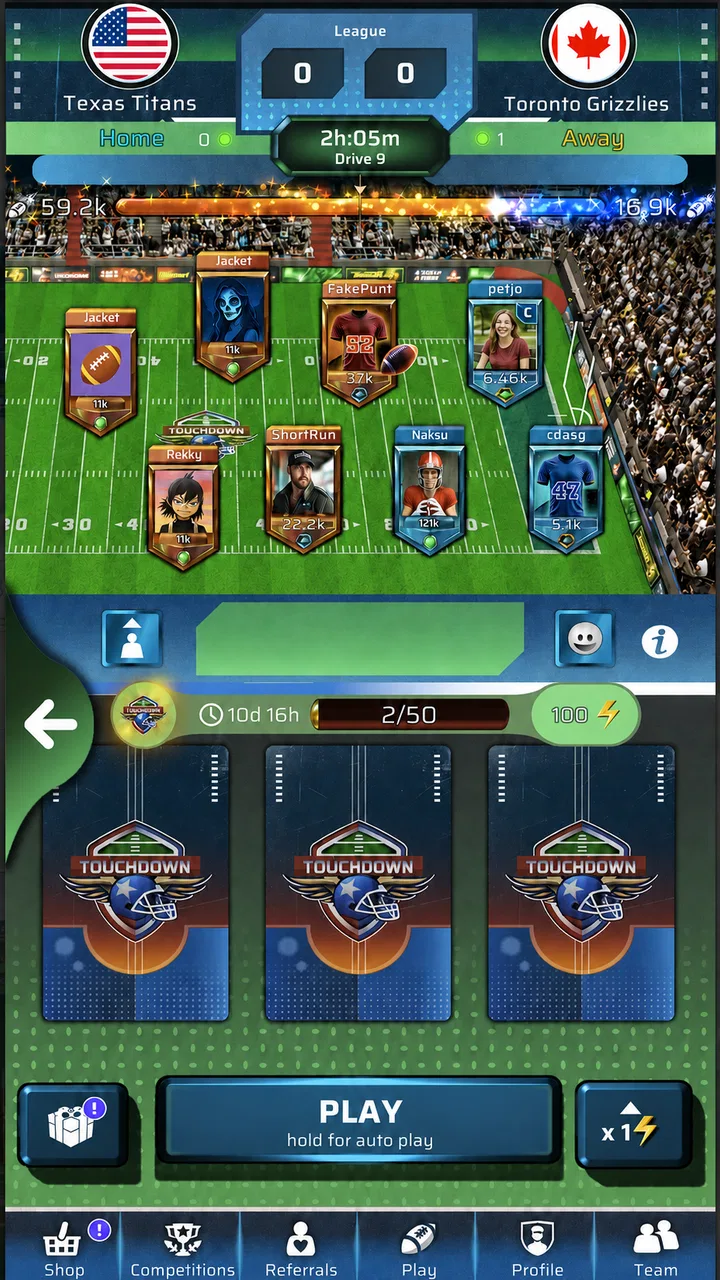
Touchdown - Football PVP Game
- 4.8
- Rating
- 10.00K
- Installs
- Free
- Price

 Analysis by App-foxy
I went into Touchdown - Football PVP Game expecting a quick sports game, but its real appeal is the feeling of making decisions against another person rather than simply completing a fixed challenge. It places the focus on competitive football, timing, and choosing what to do under pressure. That makes it a better fit for players who enjoy short strategic contests than for anyone looking for a deep offline simulation or a long story campaign.
The game is free to download and is listed for Everyone, which makes it approachable for younger players and casual sports fans. It comes from Laser Focus s. r. o., and its current version is 1.65.3. I also like that the store presence is still relatively focused: the game has passed 10K installs, with a 4.8 average from 438 ratings and 30 written reviews. Those figures suggest a small but enthusiastic player base rather than a giant, anonymous sports platform.
What a first-time player should expect
The central idea is simple: build a football dynasty, compete with real players, make the important calls, and work upward through the rankings. That wording points to a game where your choices matter as much as your reflexes. I would not approach it as a full console-style football recreation with every position and playbook represented in exhaustive detail. Its strongest identity is a focused player-versus-player experience.
You May Also Like

 Blood Strike: 2.5 Anniversary
Blood Strike’s Loadouts Turn Every Drop Into a Tactical Gamble
A close look at Blood Strike’s custom loadouts: how fast access to signature weapons reshapes its battle royale rhythm, rewards preparation, and narrows the gap between fights.

 Pandora - Music & Podcasts
Pandora’s Music Is Easy to Start, but Harder to Recover
Pandora’s strength is its low-effort path from a seed to a station. Its weak spot is how much confidence it asks you to place in connection, setup, and quiet recovery.

 8 Ball Pool
 Is Built on Rivalries, Rematches, and Routine
A close look at the rivalries, rematches, shared routines, and unanswered safety questions that turn a quick pool match into a persistent mobile community.

 Samsung Music
’s Quiet Strength Is Playing What You Already Own
Its reach comes less from spectacle than from dependable access to a personal library. That simplicity is both the app’s strongest retention engine and its ceiling.

 AccuWeather: Weather Radar
AccuWeather Review: A Quick, Clear Forecast for Everyday Decisions
For everyday plans, the best forecast is the one you can understand quickly. AccuWeather makes rain timing, radar, and local conditions easy to act on, with a few trade-offs.

 Hill Climb Racing
Why Hill Climb Racing Still Turns Crashes Into One More Run
A tiny car, a bumpy hill and one more upgrade: Hill Climb Racing keeps resurfacing because its simple chaos makes every near-miss feel personal.
More From Our News Desk



That distinction is useful before installing. If you want to control a complete match minute by minute, manage a detailed roster, or recreate the full complexity of professional football, a traditional football simulator may suit you better. Touchdown is more appealing when you want a compact competitive loop: enter a contest, read the situation, choose an action, and see whether your decision moves you closer to victory.
The “dynasty” idea also changes how I think about progression. You are not only chasing one isolated win. The broader motivation is to improve your standing over time and create a sense of continuity between matches. That can make even a short session feel meaningful, because the result contributes to a longer climb rather than disappearing when the screen closes.
At the same time, competitive progression can be demanding. A player who dislikes losing to another human, repeating a difficult matchup, or making a decision without knowing the opponent’s response may find the experience stressful. I would recommend it to someone who sees a defeat as information. If you want a calm sports game where every attempt can be completed at your own pace, this is probably not the best first choice.
The best way to approach the opening session
My advice is to treat the first few games as observation rather than a test of expertise. Resist the urge to spend anything immediately or to judge the whole game after one awkward result. Watch what the game asks you to decide, notice how quickly you need to act, and learn which moments seem to carry the most weight.
A useful beginner habit is to separate a bad outcome from a bad decision. Sometimes a sensible call will fail because the opponent anticipated it. That is different from choosing without understanding the situation. After each contest, ask yourself what information you had, what you expected to happen, and whether the result changed your view. This simple review process is more valuable than blindly repeating the same move.
Because this is a player-versus-player game, the first meaningful success may not be a dramatic winning streak. It may be recognizing an opponent’s pattern, choosing a response with a clear reason, and seeing that decision work. That is the moment when the game starts to feel less random and more like a contest you can learn to read.
Getting started without unnecessary friction
The game is available at no upfront cost, so the initial decision is easy: install it, explore the opening flow, and decide whether the competitive rhythm suits you. The listed minimum operating system is Android 7.0, which keeps the compatibility requirement modest for Android users with older devices. On iOS, the practical experience will still depend on the device and the version of the operating system, so I would keep the usual expectation that newer hardware may feel smoother.
When you first open it, focus on understanding the path from the main screen into a contest. Look for the place where you enter a match, the area that represents your progress, and any screen connected with improving or expanding your team. Even if the interface feels obvious, taking a moment to identify these destinations prevents a common beginner mistake: tapping through quickly and then not knowing where a result or reward went.
I would also make a clear distinction between progression and purchases from the beginning. The game is free, but it includes optional in-app purchases ranging from $0.99 to $499.99 per item. That is a very broad range, and it is the main point where I would ask younger players to involve a parent or guardian. Adults should also decide on a spending limit before experimenting with paid items, especially in a competitive game where the desire to catch up can become emotional.
The safest early workflow is straightforward:
Complete the opening steps slowly enough to understand what each screen is asking you to do.
Play before considering any purchase, so you know whether the decision-making loop is enjoyable on its own.
Record which situations confuse you instead of spending to solve them immediately.
Only consider an optional item after you understand what it changes and why it would improve your particular style of play.
This approach matters because a purchase can remove a short-term obstacle without teaching you how to make better calls. For me, the most satisfying part of a competitive sports game is gaining understanding. Spending should remain a deliberate choice, not a reaction to one frustrating defeat.
Finding the first successful action
Your first real breakthrough should come from making a purposeful call rather than simply pressing the most obvious option. Before acting, identify the situation, consider what an opponent would expect, and choose the response that best matches your intention. Even if the game keeps the controls accessible, the competitive layer comes from making that choice with incomplete information.
A practical routine is to use your first few contests to test one idea at a time. For example, you might concentrate on avoiding predictable decisions, then use the next contest to watch how an opponent responds when you change your timing or selection. Do not try to master every possibility at once. A narrow experiment gives you a clearer lesson than a match in which every decision changes randomly.
When a choice succeeds, pause long enough to understand why. Was the opponent expecting something else? Did you wait instead of rushing? Did you recognize a repeated pattern? That explanation is more valuable than the win itself because it can be applied later. A player who understands the reason behind a successful action is better prepared when the next opponent behaves differently.
The same method works after a loss. If you made a rushed choice, write that down mentally. If you selected the sensible response but were outguessed, note the possibility that your pattern has become visible. This is one of the non-obvious strengths of a focused PVP game: a short match can provide a concentrated lesson in prediction, patience, and adaptation.
I would also avoid changing several habits after one result. If you alter your approach, timing, and preferred decisions all at once, you will not know what helped. Change one element, play again, and compare the experience. That makes progression feel earned rather than mysterious.
Common points of confusion
The first likely confusion is the difference between a football theme and a football simulation. Touchdown uses football as the setting for competition, but the store positioning emphasizes calling the shots and battling real players. I would therefore expect the important skill to be decision-making within the game’s own format, not necessarily the same controls or tactical depth found in a large console title.
Another point is the meaning of rankings. Climbing a leaderboard is motivating, but it can also encourage players to focus only on the result. A ranking is a useful signal of progress, not a complete measurement of skill. If you are still learning the game, a lower position does not mean your decisions are pointless. It may simply mean you are encountering more experienced opponents or still developing a consistent approach.
Players may also wonder whether the game is suitable for quick everyday sessions. In my view, it is most naturally suited to short breaks, such as waiting for an appointment or taking a few minutes after work. The competitive format gives those moments a clear purpose. However, because another player is involved, you should start a contest when you can give it your attention. Beginning a match while distracted can turn a winnable situation into a frustrating one.
A realistic example would be a commute where you have a few uninterrupted minutes. I would open the game, review the current progression screen, play one focused contest, and stop after considering the key decision. That is a healthier routine than launching it repeatedly during every spare second and allowing the ranking system to dictate your mood. The game works best as a deliberate burst of competition, not as background activity.
The purchase system is another area that deserves clear thinking. The presence of low-cost items alongside items priced as high as $499.99 means the word “free” describes access, not necessarily every possible route through progression. I would never recommend buying simply because an opponent appears stronger. First identify whether the problem is lack of knowledge, an unfavorable matchup, or a genuine progression barrier. Only the last of those might justify investigating a paid option, and even then, the decision should be made calmly.
Age guidance also deserves context. The Everyone rating makes the game broadly accessible, but competitive pressure and optional spending are separate considerations. Parents should explain that losing is normal and that purchases require permission. Younger players may understand the football action quickly while still needing help with the financial side of the experience.
How it compares with familiar sports alternatives
Compared with a conventional football simulator, Touchdown appears better suited to players who want a streamlined competitive decision loop. A full simulation usually rewards knowledge of formations, player control, match management, and detailed team construction. Here, the attraction is the direct contest and the opportunity to outthink another player without committing to a long, elaborate match.
Compared with an offline arcade sports game, the human-versus-human element gives each encounter more unpredictability. An artificial opponent can be learned through repetition, while a real player may change approach after noticing your habits. That makes the game more replayable for people who enjoy adaptation, but it also removes some of the comfort of a fully predictable solo experience.
Compared with a management-focused football game, the dynasty and ranking ideas may provide a lighter sense of long-term ownership, while the immediate competition remains central. If your favorite part of sports games is adjusting budgets, scouting, and building a complex organization, another title will likely offer more depth. If you prefer seeing whether your next call beats another person’s expectation, this one is more focused.
That focus is both the product’s advantage and its limitation. It keeps the premise easy to understand, but players seeking a broad collection of modes may eventually want more variety. I would choose it for concentrated PVP football, not as my only sports game.
Building a better routine after the first win
Once you have achieved a meaningful success, the next step is not to chase the ranking blindly. Build a repeatable routine. Start by identifying the decisions you make confidently, then find the situations where you hesitate. Your practice should target the second group, because comfortable choices rarely reveal where improvement is needed.
One useful technique is to create a small mental record after each contest: the situation, your choice, the opponent’s response, and what you would test next time. This takes only a moment, but it prevents matches from blending together. It also helps you see whether a losing streak comes from one recurring mistake or from opponents adapting to a once-effective pattern.
Another advanced habit is to protect your attention. Do not play immediately after an irritating loss if you are tempted to recover the ranking at any cost. Take a break, return with one specific adjustment, and stop again if your decisions become rushed. In a competitive game, emotional control is not separate from skill; it directly affects the quality of the calls you make.
Be selective about progression spending as well. The wide purchase range means it is especially important to understand the value of any item before paying. Ask yourself whether it improves learning, saves time, or merely offers a temporary feeling of being stronger. I would personally favor anything that supports a clearer understanding of the game over anything that simply masks uncertainty.
The current version, 1.65.3, gives new players a clear version reference when discussing their experience or troubleshooting with other users. Since the game is still a relatively small release in terms of installs, community advice may be more limited than it is for major sports franchises. That makes your own notes more useful, particularly if you discover a reliable way to interpret a confusing situation.
After several sessions, you should be able to answer three practical questions for yourself: Do I enjoy the decisions even when I lose? Can I explain why my successful calls worked? Am I comfortable with the optional spending model? If the answer to all three is yes, the game has a good chance of becoming a satisfying competitive break in your day.
Who should install it, and who should skip it
I would recommend Touchdown to a player who likes football themes, quick competitive encounters, and the mental challenge of reading another person. It is especially suitable if you enjoy gradual improvement and want a game where a clever decision can matter more than simply having the fastest fingers.
I would be more cautious recommending it to someone who wants a completely offline experience, a detailed simulation, or a relaxed game with no rankings and no competitive pressure. I would also suggest skipping it if the possibility of optional purchases makes you uncomfortable, since the listed range reaches from $0.99 to $499.99 per item.
For families, the Everyone rating is reassuring as a general age classification, but I would still set expectations around screen time, losing, and spending. For adults, the main question is whether the focused PVP structure offers enough variety for long-term interest. Some players will appreciate the concentration; others will quickly miss the breadth of a larger football package.
My final impression is positive but specific. This is not trying to replace every football game on your phone. It is a free sports game built around competitive calls, real-player opposition, and the satisfaction of climbing over time. Its strongest feature is the compact decision loop: observe, choose, adapt, and try again.
I would install it, play without spending during the learning phase, and judge it after I had enough matches to recognize patterns rather than after one result. If that process feels rewarding, the game can become a smart choice for short, focused sessions. If you mainly want full-team control, deep simulation, or a purely solo experience, a different football alternative will serve you better. For the right player, though, Touchdown - Football PVP Game offers a clear and approachable route from first call to meaningful competition.
FAQs for Touchdown - Football PVP Game
01What is Touchdown - Football PVP Game?
Touchdown - Football PVP Game is a competitive mobile sports game focused on short, real-time American football matches. Players build and manage a team, choose offensive and defensive plays, and compete against other users in online player-versus-player games. Its pick-up-and-play design makes it accessible for beginners, while timing, play selection, and team upgrades add more depth for regular players.
02How do matches work in Touchdown - Football PVP Game?
Matches are generally designed to be quick and easy to follow, with players taking turns or making strategic decisions during offensive and defensive situations. Success depends on selecting suitable plays, reacting to the opponent, and using your team’s strengths effectively. Although the controls are simpler than a full console football simulation, winning still requires good timing and an understanding of football tactics.
03Does Touchdown - Football PVP Game require an internet connection?
Because the main experience is based on competing against real players, an internet connection is normally required for matchmaking, live games, account progress, and leaderboard features. This means the game may not be suitable for playing fully offline. A stable Wi-Fi or mobile-data connection is recommended, especially during competitive matches, since interruptions can affect performance or cause a game to end unexpectedly.
04Is Touchdown - Football PVP Game free to download and play?
Touchdown - Football PVP Game can generally be downloaded and played without an upfront purchase, but it may include optional in-app purchases. These can be used for items such as upgrades, packs, resources, or other progression-related benefits, depending on the current version. Players who prefer not to spend money should review the available rewards and progression system and disable purchase permissions if needed.
05Is Touchdown - Football PVP Game suitable for children and casual players?
The game is approachable for casual players because its matches are shorter and its controls are less complicated than traditional football simulations. However, parents should check the age rating, advertising, chat or social features, and in-app purchase options before allowing children to play. New users may also need time to understand team development, competitive matchmaking, and the advantages provided by upgraded players or equipment.
Pros
- Quick PvP matches are easy to fit into short gaming sessions.
- Simple controls make it accessible for newcomers to football games.
- Competitive rankings add motivation to keep improving.
- Matches feel more exciting when facing real online opponents.
- The arcade-style gameplay is lighter and faster than a simulation.
Cons
- Online matchmaking may pair players with noticeably different skill levels.
- Progress can feel slow without regular play or upgrades.
- Limited tactical depth may disappoint serious football fans.
- Connection issues can affect the outcome of live matches.
- Repeated matches may become predictable after extended play.

Touchdown - Football PVP Game
Gallery